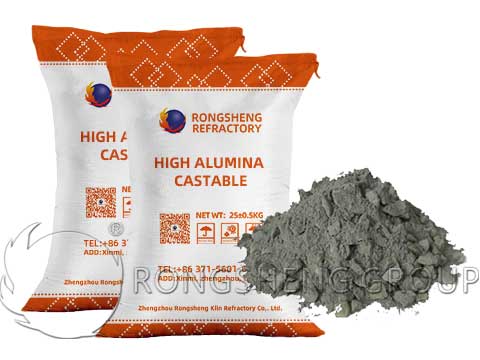
High-alumina castables refer to refractory castables with an Al₂O₃ content greater than 48%. They are characterized by high cold and hot strength, good wear resistance, thermal shock resistance, spalling resistance, and good volume stability at high temperatures. They have a wide range of applications, including cement kiln heads and tails, cyclone preheaters, tertiary air ducts, grate coolers, refining furnace covers, blast furnaces, and heating furnaces.
Performance and Application Advantages of High-Alumina Castables
Traditional lightweight high-alumina castables, due to their large pore size, have high thermal conductivity and can only be used in low-temperature applications (≤1200℃). According to conventional refractory principles, if a material can form a closed, circular microporous structure, its thermal conductivity can be significantly reduced. To improve the performance of lightweight high-alumina castables, high-performance lightweight high-alumina castables with lower thermal conductivity, higher strength, and greater volume stability have been developed by adding pore-forming agents.
Scientific formulation further enhances the high-temperature strength and thermal stability of this series of castable refractory materials, effectively controlling the calcium oxide content and reducing the low-eutectic phase, thereby improving refractoriness, high-temperature strength, and slag resistance. This series of castables is mainly composed of high-alumina refractory raw materials, employing new micronized powder technology and highly efficient composite chemical additives. It features high load softening temperature, long service life, and convenient construction, and has a significant effect on improving insulation, reducing heat loss, and lowering ambient operating temperature.
Suitable for heating furnaces, soaking furnaces, heat treatment furnaces, rotary kilns; linings for various high-temperature burners, water pipe wrapping linings for heating furnaces, components for ladle refining equipment in molten steel, and high-temperature wear-resistant linings for petrochemical catalytic cracking reactors; linings for blast furnace tapping troughs, blast furnace tapping channels, and integral powder spraying guns for molten iron pretreatment. It can also be used to fabricate large precast blocks and furnace linings for rapid construction.
What are the causes of cracks in the refractory castable after furnace drying?
Furnace drying is a crucial step after the construction of high-alumina castables but before operation, directly determining the future service life of the kiln. During furnace drying, proper preparation is essential, the drying time must be carefully controlled, and the kiln’s temperature rise curve must be operated under strict conditions. Improper furnace drying operations may lead to engineering quality accidents such as castable cracking.
Under normal circumstances, after the furnace drying process, the kiln can operate normally after passing the engineering acceptance test, and the castable will achieve its performance within the operating temperature range. There are three main reasons for cracks in the castable after furnace drying:
- The amount of water added during wet mixing of the high-alumina castable was not properly controlled. Adding too much water results in insufficient bonding strength, leading to castable detachment. Adding too little water will also significantly weaken the performance of the castable. Therefore, the amount of water added must be strictly controlled according to the instructions.
- Insufficient curing time during the curing of the high-alumina castable results in insufficient strength of the formed castable. Generally, the curing time for castable is 24 hours at higher temperatures. In colder winters, the curing time is 48 hours. If the temperature is low, a small amount of accelerator may be added to speed up the setting process.
- The temperature rises too quickly during furnace drying. The boiler temperature rise curve must be carefully controlled during furnace drying. During furnace drying, construction workers typically develop a drying curve based on the boiler’s specific conditions. Strict temperature control is crucial during drying to prevent rapid heating and cooling. After drying, if minor or inconspicuous cracks appear in the castable refractory, they should be promptly inspected and repaired with the same type of refractory. However, if larger cracks appear or if refractory detachment occurs, construction workers must develop a solution and repair the damage with new castable refractory.