
Phosphate castables play an irreplaceable role in the construction of high-temperature kilns in many fields. Rongsheng Refractory Castable Manufacturer boasts an environmentally friendly and advanced monolithic refractory material production line, specializing in the production of integral refractory lining materials for high-temperature industrial furnaces. Contact Rongsheng for free samples and quotations.
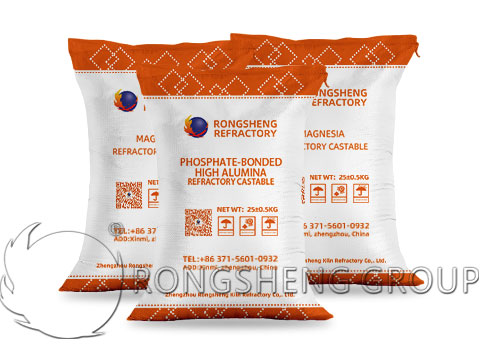
Characteristics and Applications of Phosphate Castables
Phosphate refractory castables are phosphoric acid-bonded wear-resistant castables, belonging to the acidic matrix, with a service temperature of 1400-1600℃. The phosphoric acid binder concentration in phosphate castables is 40%~60%, with an addition amount of 10%-14%. Aluminate cement is commonly used as a setting accelerator, with a dosage of 0.5%~3.0%. A certain proportion of fine magnesium oxide powder is also added.
At room temperature, phosphate refractory castables do not react with aluminosilicate materials except for iron. During construction, heating is required to dehydrate and condense the binder, adhering and cementing the aggregate powder together to achieve room temperature strength. When fine magnesium oxide powder is added, it reacts with phosphoric acid, causing the refractory castable to set and harden. When aluminate cement is added, it forms hydrated mono- and di-hydrogen phosphate. The physicochemical changes of phosphoric acid and phosphate refractory castables during heating are very complex. It reacts with refractory powder or additives to form phosphates, which are further dehydrated into metaphosphoric acid or metaphosphate. With continued temperature increases, polymerization, polycondensation polymerization, and primary cementation adhesion occur. Simultaneously, a ceramic bond is formed, giving the refractory castable better high-temperature performance.
Phosphate refractory castables use clay clinker or bauxite aggregate clinker as refractory aggregate and powder, with dosages of 65%-74% and 24%-35%, respectively. A common mix design is as follows: refractory aggregate with a particle size less than 15mm, with a particle size distribution of 15-5mm 50%, 5-2.5mm 24%, and less than 2.5mm 26%. The refractory powder fineness is greater than 80% less than 0.09mm. The accelerator is CA-50 high-alumina cement, the dosage of which depends on construction conditions and room temperature strength requirements. The standard dosage is around 2%. When the ambient temperature is low, the dosage should be increased appropriately. If room temperature strength is not required, CA-50 cement can be omitted or added in small amounts.
Phosphate castables are used in heating furnaces and soaking furnaces for heating metals, and can also be used in coking ovens, etc.
Performance Characteristics of Phosphate Castables
Phosphate castables are castables bonded to phosphates or other phosphates. Their hardening mechanism depends on the type of binder used and the method of accelerating hardening. The binder in phosphate castables can be phosphoric acid or a mixture of phosphoric acid and aluminum hydroxide to produce aluminum dihydrogen phosphate. At room temperature, the binder does not react with aluminosilicate materials (except iron), so it must be heated to dehydrate and shrink, thereby binding the aggregate powder and achieving room-temperature strength. When using a setting accelerator, heating is not required; fine magnesium oxide powder or high-alumina cement can be added to accelerate setting. After adding fine magnesium oxide powder, it reacts rapidly with phosphoric acid to form a hardened refractory material. Adding aluminate cement forms phosphates with good setting properties, such as hydrated phosphates like monocalcium phosphate and dicalcium phosphate, which then harden the material.
From the hardening mechanisms of phosphoric acid and phosphate refractory castables, it can be seen that only when the reaction rate of the binder, refractory aggregate, and powder is appropriate during heating can a high-quality refractory castable be formed. However, during the crushing, ball milling, and mixing processes, refractory raw materials are prone to introducing impurities such as metallic iron. These impurities react with the binder during mixing, releasing hydrogen gas, which causes the refractory castable to expand, resulting in a loose structure and reduced compressive strength. This process is detrimental to the production of ordinary phosphoric acid and phosphate refractory castables.
Methods to Eliminate Expansion
- Material Settling: High-temperature refractory aggregates and powders are thoroughly mixed, placed in a silo or storage area, covered with plastic sheeting to prevent water contact, and allowed to stand for a period of time. This allows the binder to fully react with the metals in the refractory aggregates and powders, releasing hydrogen.
- Washing and Magnetic Separation: The powder is crushed using a ceramic ball mill or washed with a strong acid (such as hydrochloric acid), and impurities such as metals are removed using magnetic separation.
- Inhibitors: The expansion of refractory castables can be reduced by decreasing the amount of binder used in the refractory material or by adding inhibitors.
Although the binder in phosphate castables does not react with the material itself at room temperature, it will slowly solidify and harden due to temperature changes or other environmental changes during storage or transportation. For long-term storage, retarders such as citric acid and tartaric acid can be added to extend the storage time.
Construction of Phosphate Castables
Formwork is required for the construction of any castable. Depending on the location within the industrial furnace, formwork is generally used for flat surfaces or curved arched surfaces, and based on material, it can be steel or wood. Formwork must be precisely dimensionally manufactured, and supports (or hanging) must be secure to prevent displacement during castable compaction. A layer of kraft paper or plastic sheeting should be laid on the side of the formwork that contacts the castable. Steel formwork should be coated with machine oil to remove surface roughness during demolding. During casting, a penetrating vibrator is generally used for compaction, stopping when the surface of the castable shows signs of slurry. Excessive compaction time will cause internal delamination, leading to a decrease in strength. Insufficient compaction time will result in a loose interior. This applies to phosphate castables as well.
Cultivation and Baking Process of Phosphate Castables
Phosphate castables are prone to absorbing moisture and deliquescence when exposed to humid atmospheres, which reduces their compressive strength. Therefore, they should be maintained in a dry environment. The ideal maintenance temperature is 20-25℃. If the ambient temperature is low, low-temperature baking is required. After a major overhaul of the hot blast stove, the ceramic burner (unfired) can be baked using an electric furnace. Phosphate castables contain a certain amount of water added during manufacturing (when diluting additives), and the castable also needs to undergo multiple dehydration processes at different temperatures to undergo crystal transformation and polymerization. Therefore, baking is necessary before using the furnace lining.
Baking also allows the castable furnace lining to reach a certain sintering strength. Improper baking can cause damage to the castable furnace lining, such as cracking, detachment, or explosion. A scientific baking curve should be developed based on the castable construction area and thickness. For furnaces where the entire lining (including walls, top, or bottom) is constructed using phosphate castable, the baking time is generally 7-10 days. Specific holding times are performed at 150℃, 350℃, and 650℃, while the temperature can be continuously increased for the remaining time. For smaller construction areas, wood or an electric furnace can be used to bake the refractory to over 350℃. At this temperature, most of the free and crystalline water in the castable will be removed. Then, the baking process can be carried out according to the conditions of the refractory brick lining furnace.
Rongsheng Refractories’ phosphate castables are characterized by strong resistance to spalling, airflow erosion, and abrasion. The physical and chemical properties of the raw materials used to manufacture the phosphate castables meet the specifications, and the amounts of binders and accelerators are strictly controlled. Sufficient time must be allowed after the first mixing. Only by meeting these requirements can qualified phosphate castables be produced.
Precautions for Using Phosphate Refractory Castables
There are several important precautions to keep in mind when using phosphate refractory castables. First, if no setting accelerator was added during the mixing and molding process, the castable can be heated and baked after standing in a natural environment for two hours, followed by demolding. If a setting accelerator was added, the molded castable can be cured in a natural environment above 10°C.
When the ambient temperature is above 20°C, demolding can be done after 3 to 5 hours of curing. However, if the temperature conditions are not met, the curing time should be extended by 5 hours before demolding. Throughout the curing process, it is crucial to ensure that the castable is completely isolated from water to avoid any form of moisture contact. This is essential because the presence of moisture can adversely affect the performance of the castable.
Furthermore, the entire curing period is 3 days. During this period, a suitable curing environment should be maintained, and the demolding time and waterproofing requirements mentioned above must be strictly adhered to. By following these precautions, the excellent performance and stability of the phosphate refractory castable can be ensured during use.
Factors Affecting the Performance of Phosphate-Bound Castables
① Cementitious Agent Concentration and Dosage
The concentration and dosage of the cementitious agent play a crucial role in the performance of phosphate-bound castables. Only when the concentration and dosage of the cementitious agent are appropriate can the castable exhibit excellent performance. From a molding performance perspective, if the concentration of phosphate is moderate but the dosage is insufficient, the castable will be too dry and difficult to mold. Conversely, if the dosage is excessive, the castable will become too thin, and the hardening rate after molding will be relatively slow.
Furthermore, the concentration and dosage of phosphate also have a significant impact on the room temperature compressive strength. With the main material composition and accelerator dosage remaining constant, the room temperature compressive strength tends to decrease with increasing phosphate concentration and dosage, and may even exhibit delayed setting or non-setting. It is worth noting that phosphate castables without added accelerators typically do not solidify at room temperature, which is a normal phenomenon.
The ideal concentration range for phosphoric acid and aluminum dihydrogen phosphate is approximately 40%-60%, while the recommended addition amount is controlled within the range of 11%-14%. It is worth noting that the optimal concentration and dosage of the binder will vary depending on the type of refractory aggregate powder used. For example, if the moisture content of the raw materials is too high, the concentration of the binder should be appropriately increased or its dosage reduced to ensure the castable performance reaches its optimal state.
② Refractory Aggregates and Fine Powders
Refractory aggregates and fine powders are the core components of phosphate castables, and their type, dosage, fineness, and particle size distribution have a profound impact on the performance of refractory castables. Therefore, in engineering applications, careful selection based on specific requirements is essential to ensure that the materials can achieve optimal performance.
Refractory aggregates play a skeletal role in refractory castables, typically accounting for about 70% of the total amount. The selection of their type has a significant impact on the performance of phosphate refractory castables. Different types and grades of aggregates exhibit varying performance characteristics; therefore, selecting suitable refractory aggregates is crucial for ensuring the performance of castables.
Simultaneously, refractory powders react with binders, undergoing a series of physicochemical changes that directly determine the final properties of the refractory castable. Experimental data shows that the post-firing compressive strength of refractory castables increases with increasing aluminum content in the powder. Particularly at around 1400℃, lower-grade powders are more conducive to sintering, exhibiting higher strength. Furthermore, the load softening temperature also slightly increases with increasing aluminum content in the powder, but its effect on parameters such as post-firing linear deformation, apparent porosity, and bulk density is not significant.
To ensure excellent performance of phosphate castables, a sufficient quantity of powder must uniformly coat the particle surface and fully react with the binder to form a strong bond. Therefore, the fineness and dosage requirements for powders used in phosphate-bonded castables are very strict: the fineness should be less than 0.088 mm, and the dosage should be approximately 30%-40%. Meanwhile, to avoid adverse effects on the performance of the castable, refractory mortar must not be used as powder, and no other impurities should be mixed into the powder.
③ Accelerator
Accelerators play a crucial role in the performance of phosphate-bonded castables. At room temperature, phosphate castables cannot set and harden on their own without the addition of an accelerator. To ensure that the castable has sufficient compressive strength to avoid damage during demolding, transportation, and hoisting, an appropriate amount of accelerator must be added. Currently, there are many types of accelerators on the market, and aluminate cement is one of the most commonly used and effective ones. Typically, adding only 2%-3% aluminate cement can significantly increase the setting and hardening speed of the castable, thereby enhancing its compressive strength and meeting various engineering requirements.