
Unshaped refractory materials—also known as monolithic refractories—consist of refractory aggregates, powders, binders, additives, and pores. They harden at either room temperature or elevated temperatures, exhibit limited shrinkage at service temperatures, and possess a refractoriness exceeding 1580°C. Some definitions specify a refractoriness of no less than 1500°C.
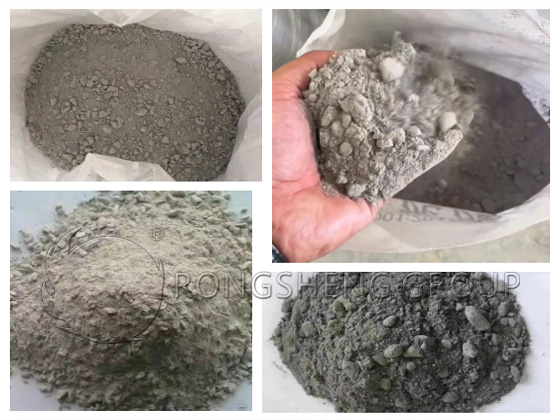
Advantages of Using Unshaped Refractories
The development and production of unshaped refractories are of great significance to the national economy, as they enable the mechanization of construction and repair processes for various thermal-processing equipment across many industrial sectors. In developed capitalist nations, unshaped refractories account for 40% to 50%—or even more—of total refractory production. In many applications, the use of unshaped refractories offers clear economic advantages over the use of small, pre-formed refractory bricks or shapes.
Compared to fired refractory products, unshaped refractories (such as large precast blocks and monolithic linings) offer a number of fundamental technical advantages. For instance, the degradation of conventional refractory masonry typically begins at the brick joints; in contrast, monolithic linings made from unshaped refractories are entirely free of such joints.
Furthermore, when compared to fired products—even those composed of the same base material and possessing identical porosity—unshaped refractories exhibit superior thermal shock resistance. As temperature drops non-linearly across the thickness of a refractory lining, varying temperature gradients emerge in different sections, resulting in distinct thermal stresses. In a structure built from fired bricks, these thermal stresses act upon a rigid, uniform framework. In an unshaped, monolithic lining, however, the material develops a structure within each section that is better adapted to the local temperature gradient. Consequently, unshaped refractories possess a greater capacity for stress relaxation.
Another key advantage of unshaped refractories is their inherently low thermal conductivity. Conversely, their primary drawbacks include relatively poor abrasion resistance and issues such as structural collapse (loss of mechanical integrity) within certain temperature ranges. Therefore, it is neither accurate nor practical to view unshaped refractories and fired refractory products as mutually exclusive alternatives.
Selection of Components for Unshaped Refractories
The selection of components for dense unshaped refractories is guided by the principles of achieving minimum porosity and minimal shrinkage. To ensure that the binder effectively fills the spaces between the aggregate particles, the mixture must possess good packing characteristics. Materials that remain stable at high temperatures and do not form low-melting-point eutectic mixtures are chosen as aggregates. In principle, any non-shrinking refractory material can serve as an aggregate.
Maximum packing density is achieved by using a blend of two types of particulate fillers—typically 60%–70% coarse particles and 30%–40% fine particles—with the maximum particle size limited to 20–30 mm. To ensure dense packing, the average diameter of the fine particles should be 6–7 times smaller than that of the coarse particles. In the context of insulating (thermal-insulating) unshaped refractories, the objective is to achieve maximum porosity while maintaining sufficient mechanical strength.
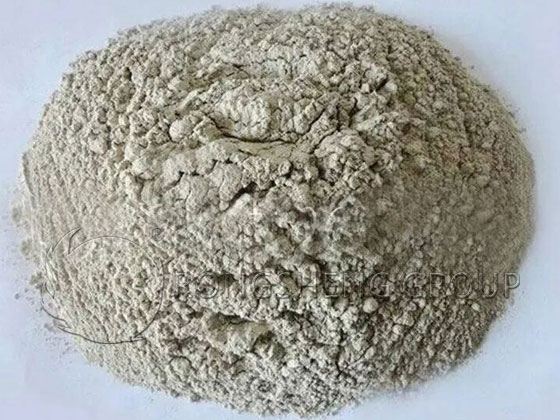
Binders for Unshaped Refractory Materials
Binders for unshaped refractory materials consist of a dispersed system comprising a dispersed phase (refractory raw materials with a particle size of less than 0.09 mm, such as cement) and a dispersion medium (chemical binders).
Based on their hardening characteristics, these binders are classified as follows:
- (1) Hydration binders: These are dispersed systems in which the dispersed phase consists of materials such as high-alumina cement, alumina-based cement, barium-aluminate cement, periclase-based cement, hemihydrate gypsum, Portland cement, or other liquid binders, with water serving as the dispersion medium.
- (2) Polymeric (polycondensation-type) and recrystallization-type chemical binders: These include orthophosphoric acid and its salts, soluble silicates (water glass), alkyl silicates, organoelement compounds, sols and gels of certain oxides, highly concentrated oxide suspensions, as well as magnesium-based, oxychloride, and oxysulfate compounds.
- (3) Coagulation-type binders: These include refractory clay, bentonite, and organosilicon substances (up to their decomposition temperature; above this temperature, organosilicon substances function as polymeric binders).
- (4) Organic binders: These include tar, pitch, starch, dextrin, and various thermal reaction products—such as aromatic or condensed aromatic structures combined with hexamethylenetetramine (acting as a hardener).
- (5) Ceramic-type binders: In this category, additives that lower the sintering temperature—along with metal powders—are incorporated into the bulk refractory material. These components significantly reduce the temperature at which a liquid phase forms, promoting solid-liquid reactions at lower temperatures and thereby facilitating sintering-based bonding at low to intermediate temperatures. When a small amount of boric anhydride (B2O3) is added to corundum-based dry-vibratable mixes, it forms a viscous liquid phase between 450°C and 550°C. This liquid subsequently reacts with α-Al2O3 (solid-liquid reaction) to produce compounds with higher melting temperatures—specifically 2Al2O3 · B2O3 (incongruent melting point: 1035°C) and 9Al2O3 · 2B2O3 (incongruent melting point: 1950°C)—which serve to bond the corundum aggregates together.
Hardening processes in monolithic (unshaped) refractories include:
- Chemical interaction between the refractory phase and the dispersion medium (chemical hardening). Example: MO + H3PO4 → M(HPO4) + H2O.
- Recrystallization resulting in the formation of chemical compounds (recrystallization hardening). Example: n[Si(OH)4] → [SiO(OH)2]n + nH2O.
- Formation of hydrates (hydration hardening). Example: 3(CaO · 2Al2O3) + aq → 3CaO · Al2O3 · 6H2O + 5Al(OH)3 + aq.
- Adhesive bonding.
Depending on the composition of the binder, the hardening of monolithic refractories may involve processes such as polymerization, polycondensation, or the formation of hydrogen bonds. The selection of a binder type is ultimately based on two fundamental criteria:
- 1) Volumetric stability of the monolithic refractory.
- 2) Maintenance of required strength across the entire temperature range, from ambient temperature to the service temperature.
Volumetric stability is a primary requirement for monolithic refractories. Shrinkage poses a significant risk, as it can lead to the catastrophic failure of the refractory mass and contribute to cracking. It should be noted that the tensile strength of monolithic refractories is significantly lower than their compressive strength.
Regarding the shrinkage characteristics of monolithic refractories, laboratory testing involves heating the material for 5 hours at its intended service temperature. For dense monolithic refractories, shrinkage should not exceed 1%, while for insulating (lightweight) refractories, the limit is 2%. These criteria are used to determine the appropriate service temperature for the material. At operating temperatures, unshaped refractory materials are permitted to exhibit an expansion of less than 3%.
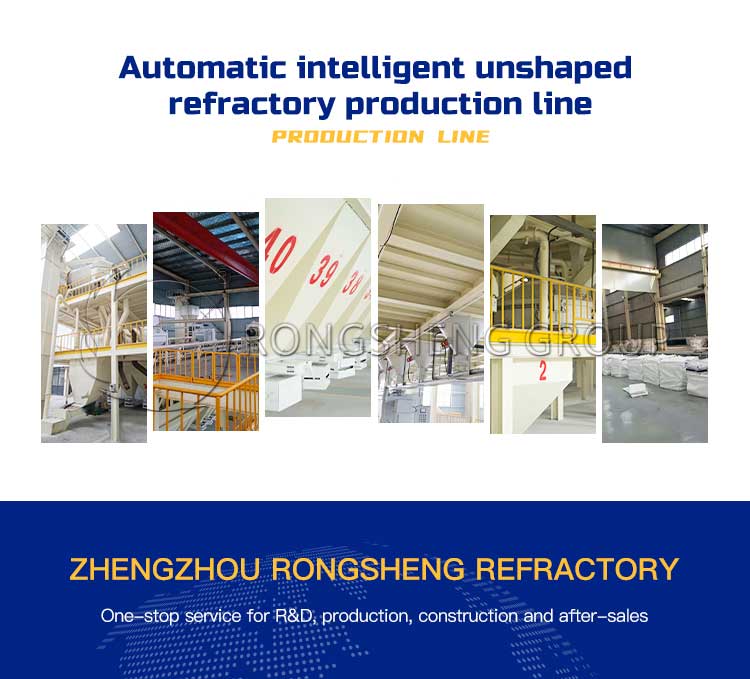
Production Process of Unshaped Refractories
When designing the composition of unshaped refractories, it is essential to ensure that the material possesses sufficient strength across the entire range of operating temperatures.
The strength of unshaped refractories varies with temperature as follows:
- (1) At relatively low temperatures (below 300°C), the material hardens, and its strength increases.
- (2) In the 300–1000°C range, the binder undergoes dehydration—losing chemically bound water—and the polymerized/condensed structure may break down, leading to a reduction in strength (often referred to as a “strength dip” or “collapse in strength”).
- (3) At temperatures above 1000°C, sintering occurs, resulting in an increase in strength.
In the production of unshaped refractories, the material generally exhibits adequate strength at room temperature, primarily due to the hardening of the binder. For precast shapes, a strength of 10–30 MPa is typically required to withstand subsequent transport and installation. While conventional castables may experience some softening, this generally does not lead to cracking or total structural failure. The overall strength of an unshaped refractory is derived from the strength of the aggregates and the strength of the binder (and the interfacial phases). Due to an uneven distribution of stress, the various components within the material exhibit different levels of strength and deformability; stress tends to concentrate on the components with a higher elastic modulus (the aggregates), while the load on components with a lower elastic modulus is reduced. Consequently, materials containing robust aggregates tend to exhibit higher overall strength.
The amount of binder used in an unshaped refractory composition often depends on the mixing and application requirements. While a higher binder content increases the material’s strength at room temperature, it also promotes the formation of a larger volume of liquid phase at high temperatures. Therefore, when determining the binder content, one must ensure that the amount of liquid phase formed at the intended operating temperature does not exceed 10%–15%.