
Temperatures in various sections of a cement kiln—including the preheater system, precalciner, riser duct, and tertiary air duct—range between 800°C and 1200°C. In these areas, due to the enrichment of alkalis within the kiln gas, the refractory materials employed are susceptible to alkali corrosion; this process readily leads to the formation of expansive minerals—such as leucite (KAlSiO4) and kalsilite (KAlSi2O6)—within the refractory bricks. Consequently, the material structure becomes porous and prone to cracking, severely compromising kiln operations. For sections where shaped refractory bricks are unsuitable, high-performance alkali-resistant castables are typically utilized as the kiln lining. Alkali-resistant castables are hydraulic refractory materials formulated using alumina-silica aggregates as raw materials, calcium aluminate cement as a binder, and appropriate chemical admixtures to impart alkali resistance.

When alkali-resistant castables come into contact with alkali vapors under high-temperature conditions, a dense glaze-like layer forms on the surface. This layer effectively inhibits further corrosive penetration, thereby extending the service life of the kiln lining. Cement and silica fume constitute the primary raw materials for refractory castables, and their respective addition levels exert a significant influence on both the ambient-temperature and high-temperature performance of the material. In this study, construction ceramics were employed as the principal raw material to systematically investigate the impact of varying cement and silica fume addition levels on the performance of alkali-resistant castables; furthermore, the microstructure of the test specimens was subjected to detailed analysis.
The Effect of Calcium Aluminate Cement Content on the Properties of Castables
This study investigates the impact of calcium aluminate cement content on the room-temperature properties of specimens subjected to heat treatments of 110°C for 24 hours and 1100°C for 3 hours. It is observed that, following the 110°C/24h treatment, the room-temperature strength of the specimens increases as the cement content rises. Conversely, following the 1100°C/3h heat treatment, the room-temperature strength of the specimens exhibits a trend of initially increasing and then decreasing as the cement content increases. Furthermore, after the 1100°C/3h heat treatment, the permanent linear change upon heating—specifically, the shrinkage rate—increases as the cement content increases. In the formulation design, the increase in calcium aluminate cement content was achieved by reducing the proportion of 200-mesh fine powder derived from construction ceramics. With the content of silica fume held constant, variations in specimen strength are primarily attributable to changes in the cement content. An increased cement content generates a greater quantity of hydration products, which serve a binding function while simultaneously filling pores within the specimen, thereby enhancing both the density and strength of the specimen.
Following the 1100°C/3h heat treatment, the hydration products formed by the calcium aluminate cement at room temperature are decomposed due to the removal of structural water, thereby losing their binding efficacy. When the cement content does not exceed 8%, the increase in the specimen’s room-temperature strength is primarily attributed to the fact that the cement particles are finer than the construction ceramic fine powder and possess higher reactivity; consequently, the majority of the strength is derived from sintering. Under the experimental conditions, when the cement content exceeds 8%, the CaO within the cement reacts with the Al2O3 and SiO2 present in the matrix to form low-melting eutectics. At high temperatures, the formation of a significant liquid phase—coupled with the dehydration shrinkage of the cement colloids, which induces cracking—leads to a reduction in strength. Therefore, the formation of these low-melting eutectics is the primary reason why the permanent linear change upon heating (shrinkage) of the specimens, following the 1100°C/3h heat treatment, increases in proportion to the increase in cement content.
Furthermore, the surface of the construction ceramic raw materials contains certain glaze components. These glaze components possess relatively low melting points and are therefore more prone to forming a liquid phase during the sintering process. On one hand, the formation of this liquid phase facilitates structural densification, acting as a sealant and enhancing alkali resistance. On the other hand, the liquid phase forms predominantly at the interfaces between the aggregate particles and within the matrix, thereby strengthening the bonding performance between the matrix and the aggregates. While this enhances the structural integration of the castable’s aggregates and matrix, it simultaneously leads to a reduction in the castable’s room-temperature toughness and an increase in its brittleness. This is particularly significant for castables, given their inherently heterogeneous internal structure; consequently, their strength becomes highly sensitive to various factors such as internal defects and cracks—factors that ultimately impact overall strength. Taking all these considerations into account, the optimal addition level for calcium aluminate cement is determined to be approximately 7% to 8%.
The Effect of Microsilica Content on the Properties of Castables
Under the condition that the calcium aluminate cement content is fixed at 7.5%, this study investigates the impact of varying microsilica content on the room-temperature properties of specimens following heat treatments at 110°C for 24 hours and 1100°C for 3 hours. It can be observed that as the microsilica content increases, both the flexural and compressive strengths of the specimens—after heat treatment at different temperatures—show an improvement; however, this trend is not particularly pronounced, and the linear shrinkage rate of the specimens increases concurrently. Microsilica is an ultrafine powder material formed through the rapid gas-phase reaction and subsequent condensation of SiO₂ and Si gases—generated during the smelting of ferrosilicon alloys and industrial silicon—with oxygen in the air. Possessing high surface activity, it functions similarly to silica sol as a binder upon hydration, thereby imparting a certain level of strength and enhancing the overall strength of the specimens following heat treatments at various temperatures. Furthermore, microsilica effectively fills the voids between the aggregates and the matrix, thereby reducing the water demand for mixing and increasing the bulk density of the alkali-resistant castable.
Microsilica serves both as a filler and a sintering promoter; when used in conjunction with appropriate dispersants, it enables the castable to exhibit superior rheological properties with minimal water addition, while simultaneously enhancing the high-temperature strength of the alkali-resistant castable. In the experimental design, the increase in microsilica content was achieved by correspondingly reducing the proportion of 200-mesh fine powder derived from construction ceramics. Since microsilica exhibits significantly higher reactivity at elevated temperatures compared to the fine powder from construction ceramics, an increased microsilica content results in a higher post-firing shrinkage rate for the specimens. Conversely, if the microsilica content is too low, it is insufficient to effectively enhance the strength of the alkali-resistant castable; conversely, if the content is excessively high, it tends to induce cracking, thereby compromising the high-temperature volume stability of the castable. Based on a comprehensive analysis, an optimal microsilica content of 5% to 6% is recommended.
Microstructural Analysis
The micrograph presented here reveals the cross-sectional microstructure of a specimen—prepared with a 7.5% addition of calcium aluminate cement and a 5% addition of silica fume—following a heat treatment at 1100°C for 3 hours. As observed, the specimen exhibits a distribution of residual micropores; however, the bonding between the aggregates and the matrix is robust. This specific structural configuration primarily facilitates transgranular fracture—a mode of failure in which cracks propagate directly through the aggregate particles—which is highly conducive to enhancing material strength. The aggregate particles are predominantly lamellar (flaky) in shape; this morphology is attributed to the source of the raw building ceramics used, their original forming method, and the subsequent crushing and processing procedures. Notably, this lamellar morphology is detrimental to improving the flowability of the castable material. Within the matrix, the introduced silica fume reacts with alumina powder to generate columnar or acicular mullite crystals. These crystals exhibit high inter-granular bonding strength and serve to intersperse within or fill the voids within the material’s skeletal framework. The network structure formed during the development of this mullite phase exerts a significant reinforcing and toughening effect on the material. Furthermore, the matrix contains a certain proportion of a glassy phase, which is beneficial for enhancing both the density and the alkali resistance of the castable. This glassy phase originates from two primary sources: the glaze components present in the raw building ceramics, and the *in-situ* formation of eutectic phases within the matrix itself.
High-Performance Alkali-Resistant Castables for Cement Kilns
(1) The change in room-temperature strength of specimens—following heat treatments at 110°C for 24 hours and 1100°C for 3 hours—is correlated with the addition amount of calcium aluminate cement. Increasing the cement content leads to an increase in the volume of eutectic phases within the specimens at high temperatures, while simultaneously resulting in a greater permanent linear change. Under the experimental conditions, an optimal addition amount of calcium aluminate cement is approximately 7%–8%.
(2) The incorporation of silica fume serves to reduce the required water content while enhancing the density and strength of the castable. Under the experimental conditions, an addition amount of 5%–6% silica fume is considered optimal.
(3) Following the heat treatment at 1100°C for 3 hours, the cross-sections of the specimens exhibit transgranular fracture; furthermore, the matrix reveals evidence of a dual reaction process involving the formation of both mullite and eutectic phases.
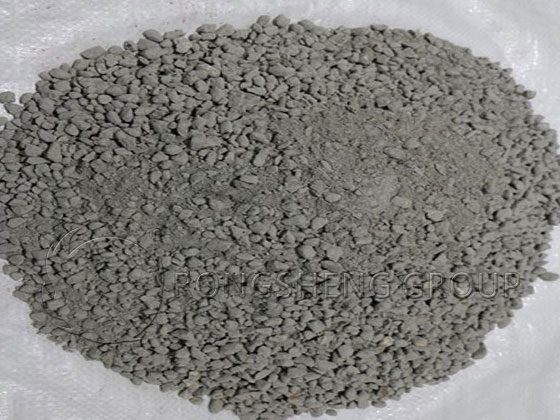
Lightweight Alkali-Resistant Castables for Cement Kilns
Lightweight alkali-resistant castables are a type of hydraulic refractory castable formulated using lightweight alumino-silicate materials as the primary raw material, calcium aluminate cement as the binder, and an appropriate amount of additives to impart alkali resistance. These lightweight refractory castables are characterized by their low bulk density, excellent resistance to alkali corrosion, and strong thermal insulation properties. At high temperatures, they react with alkali metal oxides to generate a high-viscosity liquid phase, forming a dense, vitrified protective layer that effectively prevents the further penetration and corrosion of molten alkali substances. Lightweight alkali-resistant refractory castables are primarily utilized as alkali-resistant thermal insulation linings in areas of kilns and furnaces subject to alkali corrosion, such as the preheaters within cement kiln pre-calcination systems, the ductwork of decomposition furnaces, and the preheating and decomposition zones of dry-process rotary kilns.
Installation of Lightweight Alkali-Resistant Castables
- Water: Clean potable water with a pH value between 6 and 8 must be used; the mixing water should be accurately weighed. Water usage: 16%–17% of the total dry material weight for Premium Grade products; 18%–20% for First Grade products.
- Mixing: A forced-type mixer must be used. All mixing tools must be clean, and mixing should continue until the material is thoroughly uniform.
Installation Precautions
- All molds intended for casting must be coated with a layer of machine oil.
- All embedded metal components must be coated with a layer of asphalt paint prior to casting.
- Lightweight castable mixtures must be used within 0.5 hours of mixing. When the casting thickness is 200 mm or less, it is advisable to cast the material to the full specified thickness in a single pour, vibrating it until it is completely compacted.
- Curing: Maintain a relative humidity of 100%. The curing temperature should be kept between 10°C and 30°C. Molds may be removed 24 hours after casting; the total curing period is 3 to 7 days.
- Lightweight alkali-resistant castables must not be mixed with, or placed in direct contact with, freshly mixed concrete.
Drying Schedule
Linings or structures constructed using lightweight alkali-resistant castables must undergo appropriate heat treatment prior to use.
- Dry at approximately 150°C to eliminate adsorbed water; the duration depends on the thickness of the material.
- Raise the temperature at a rate of 25°C/h up to approximately 500°C; this rate may be adjusted based on the specific section of the structure and practical feasibility.
- Maintain a constant temperature of approximately 500°C for 2 days.
- From approximately 500°C, raise the temperature at a rate of 30–50°C/h until the operating temperature is reached.
- Maintain the operating temperature for a minimum of 2 days, adjusting the duration based on the specific requirements and practical constraints of the various sections of the structure.