The most important consideration for flue lining is the erosion and corrosion caused by acidic gases. Acidic gases necessitate the use of acid-resistant castables or acid-resistant bricks for the lining. However, flues can be vertical or horizontal; for vertical flues, weight must be considered. If they are too heavy or the chimney is too tall, installation and assembly will be extremely difficult.
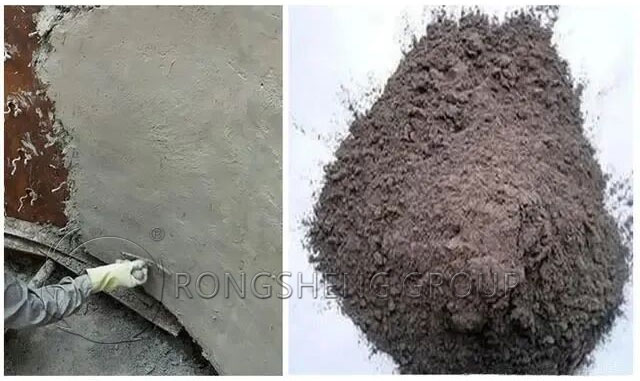
Flue Lining Using Castable Refractory
Flue temperatures are not high, but the gas pressure is high, and the flue gas volume is large. The lining is susceptible to acid erosion and water erosion due to the generation of water vapor. Therefore, careful consideration is needed when choosing castable refractory or refractory bricks for the lining.
For example, roasting furnace flues can be vertical or horizontal, and the vertical and horizontal structures are often connected. Therefore, when selecting materials for the lining, both weight and erosion must be considered. If acid bricks are used, the mortar joints will result in poor airtightness. If heavy acid-resistant castable refractory is used, it will be too heavy. If lightweight acid-resistant castable refractory is used, its erosion and scouring resistance is insufficient, which is not suitable for flue lining applications. Furthermore, since the flue lining temperature is not high, insulation is generally not required.
Therefore, semi-heavy acid-resistant castable refractory should be considered. Semi-heavy refractory has a bulk density of around 1.5, which provides resistance to erosion and scouring while also offering some insulation. Another reason is that the weight issue is also alleviated. Currently, considering market conditions and chimney characteristics, semi-heavy acid-resistant castable is an ideal material for flue linings. It is particularly suitable for use in large-diameter flues.
What is the thickness of the castable lining for a chimney?
Fluid ducts typically have small inner diameters. If acid-resistant castable lining is used, the thickness is generally less than 100mm, resulting in a significant weight reduction. However, the small diameter of the lining can cause unnecessary difficulties during construction. For flues with a diameter of less than 2 meters, using a coating material is a better alternative, as semi-heavy coating materials can be 30-50mm thick. This reduces the weight by approximately 50% compared to castable lining. For vertical flues, this further reduces the potential for excessive weight. It also facilitates construction in small-diameter flues. Therefore, semi-heavy acid-resistant coating materials are an ideal choice for small-diameter flues.
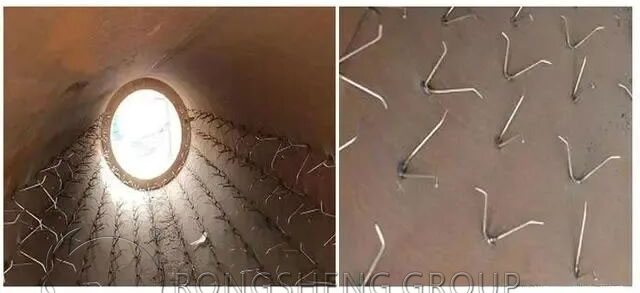
Construction of Flue Lining with Castable Refractory
The construction of flue lining with castable refractory can be carried out after installation or after the lining is installed. When constructing the flue lining with castable refractory, a 3mm gap should be left between each cast section for expansion joints. The process involves applying sealant to adjacent sections of the castable refractory before pouring the next section.
Construction of Flue Lining with Castable Refractory Before Installation
Constructing the lining after installation is generally preferable. Large-diameter flue linings are easier to construct with castable refractory. However, if the large-diameter pipe is heavy, lining before installation will significantly increase the pipe’s weight, increasing installation risk and making component welding difficult. Large-diameter flue linings are best constructed after installation.
The construction of flue lining with castable refractory before installation is suitable for small-diameter flue linings due to its lighter weight. Pre-installation construction reduces the difficulty of high-altitude operations, as the refractory lining is poured on the ground, resulting in lower labor intensity and higher construction efficiency. The disadvantage is that the lining construction cannot be carried out continuously, and expansion joints are difficult to handle.
Safety is the primary concern during construction.
The primary concern in constructing flue linings using refractory lining is safety, followed by the welding of anchors and the refractory pouring method. For large-diameter flues, the anchor nails are welded first, and then the anchors are painted before proceeding with the construction in sections. Sectioning involves constructing two sections within a 180° radius, then rotating the pipe 180° to construct the third and fourth sections. If there is an insulation layer, the insulation refractory lining is constructed first, followed by the working layer of the wear-resistant refractory lining. Additionally, if two types of refractory lining are used, the construction must also be carried out in four sections. However, a 12-hour break must be observed after each section is completed before proceeding to the next section. The lower half is poured first, and then the flue is rotated on the ground to pour the remaining half.
Lining Construction on the Ground
If lining construction is carried out on the ground, pipe openings must be straightened and anti-deformation measures implemented. This is to prevent pipe opening deformation due to weight differences during construction and rotation. Areas prone to deformation during refractory lining construction should not be constructed initially; lining should be applied to these areas after other parts are completed.
For pipe bends, expansion joints, and valves, refractory lining should be applied in sections, with expansion joints reserved in both horizontal and vertical directions. For lower-lying areas, inclined formwork can be used for refractory lining, followed by vibration to ensure compaction, and excess material should be removed tangentially. In areas with limited space or high construction joints, refractory lining should be applied using a flat butt joint, with a 3mm high-temperature resistant ceramic fiber felt sandwiched within the joint before welding.
What Type of Refractory Castable is Best for a Kiln Operating at 1500℃?
When the operating temperature of a kiln is 1500℃, corundum castable should be selected based on the temperature. However, many users don’t understand this and think that because it’s expensive, they should choose general high-alumina castable.
However, if the operating temperature is directly at 1500℃, general high-alumina castable is not suitable. Brown corundum castable is required to meet the requirements. Some users have suggested using steel fiber castable. However, this is also not an option because steel fibers begin to melt above 1300℃. Therefore, steel fiber castable cannot be used.
However, some users suggest using stainless steel, but this is also not suitable. Because the lining only uses rust as an anchor, it does not provide high-temperature resistance or corrosion resistance. Corundum castable is characterized by the highest bulk density, the lowest apparent porosity, and good high-temperature resistance, corrosion resistance, and thermal shock resistance. Moreover, the characteristics of corundum castable are fully realized at 1500℃. If steel fiber castable is used, it cannot withstand temperatures up to 1500°C. General high-alumina castables, however, can be used at temperatures of 1300°C-1400°C.
However, for different kilns with varying gas fields and degrees of corrosion, corundum wear-resistant castables or high-strength wear-resistant castables can be selected. This provides both high-temperature resistance and corrosion resistance. For example, in waste incinerators, the temperature is not high, but the degree of corrosion is strong, sometimes involving both acid and alkali corrosion. In such cases, corundum castable is unsuitable because the temperature is too low for the corundum to be fully utilized. Using clean, wear-resistant castables can resist acid or alkali corrosion. Moreover, they are cheaper than corundum castables, making them cost-effective and suitable for the special conditions of incinerators.
In short, regardless of the material of the refractory castable chosen, it is essential to select the appropriate refractory castable based on the specific kiln, temperature, and degree of corrosion.